Spring always brings a shift in what feels right on your nails. The heavy, moody tones of winter start to feel heavy in a different way, and suddenly you want something lighter, brighter, or just a little more alive. Spring nail designs for 2026 are leaning into that feeling hard — think sheer washes of color, graphic florals, aura-gradient effects, and minimalist details that punch above their weight.
This article covers over 50 trending nail looks across multiple categories; from simple one-coat styles you can do on a weeknight to more involved designs that are absolutely worth the extra time. Some require a steady hand or a specific tool. Others are genuinely beginner-friendly. Where a technique is tricky, that will be noted, and where something commonly goes wrong, there will be a fix for it too.
What You Will Need?
- Sheer or jelly-finish base polish in pink, lilac, or peach – $4–$8 at most drugstores
- White nail polish (opaque, for florals and French tips) – $3–$6
- Nail striping tape (for geometric lines and blocking) – $2–$5 on Amazon
- A fine nail art brush (liner brush, size 00 or 000) – $4–$9 at beauty supply stores
- Dotting tool or a bobby pin as a substitute – $2–$6
- Gel top coat with a UV/LED cure lamp if you want longer wear – $10–$25 for the lamp, $6–$12 for the gel coat
- Cuticle oil – $4–$9; use it before you start and after you’re done
- Nail dehydrator or prep solution – $5–$10; this step makes everything stick better and last longer
Soft and Sheer Spring Nails 2026
Jelly Nails with a Tinted Wash
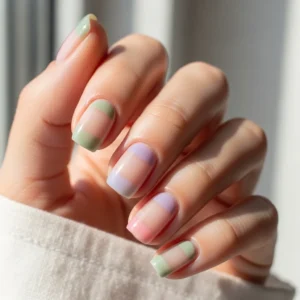
Jelly nails have been circulating since last year, but the 2026 version is more refined. Instead of a thick, candy-like finish, spring is about thin, translucent layers of color that let the natural nail plate show through. Think sheer rose, watery lavender, or a barely-there sage.
Apply two thin coats of a sheer formula, letting each coat dry for a full 60 seconds before the next. Rushing that step causes streaks, especially with lighter formulas that self-level differently than opaque polish. The effect should look like your nails are faintly tinted, almost like colored glass.
Milk Bath Nails
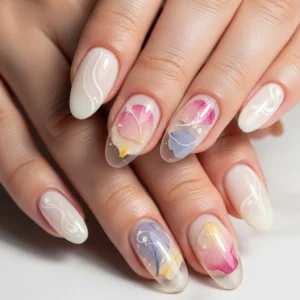
Milk bath nails are having a major moment. The look involves a creamy, off-white base with dried flower petals or abstract white swirls suspended underneath a thick gel top coat. The flowers sit on top of your base coat, then get sealed in with one or two layers of gel.
This one takes patience. Place your petals while the base coat is still slightly tacky — that’s the trick for getting them to stay flat without shifting. Once they’re sealed under gel and cured, the finish is surprisingly durable.
Floral Nail Designs for Spring
Five-Petal Freehand Flowers
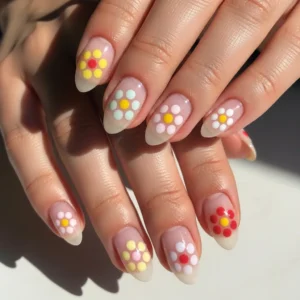
This is the design that’s been everywhere on Pinterest this spring. Five small dots arranged in a circle, each touched with a dotting tool or the rounded end of a bobby pin, form a simple flower. Using a contrasting polish for the center dot completes the look.
Work on one nail at a time, and let the dots set for 30 seconds before adding the center. If you drag into a dot by accident while placing the center, the whole flower smears. That 30-second wait makes a real difference.
Painted Daisy Tips
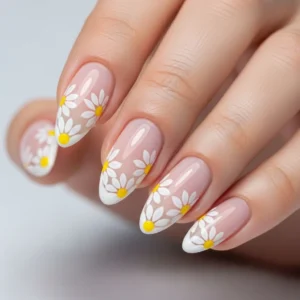
Instead of a traditional French tip, paint white petals along the free edge so they bloom upward from the tip line. The petals don’t need to be perfect — slightly uneven shapes actually look more natural and hand-painted. Finish with a yellow dot at the cuticle line end of each petal cluster.
This is moderately tricky if you’ve never used a fine liner brush. Practice on a piece of paper or on your non-dominant hand first.
Watercolor Floral Swirls
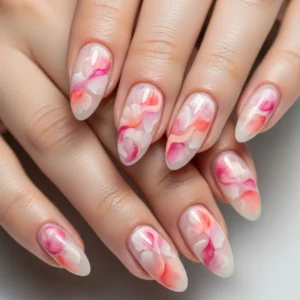
Thin your nail polish significantly with a drop of nail polish thinner (not remover) to get a watercolor effect. Apply it loosely across the nail plate in soft, overlapping brushstrokes of pink, peach, and coral. The thinned formula bleeds slightly at the edges, which is exactly the effect you want.
This technique is forgiving because imprecision reads as intentional. It is one of the better options if freehand detail work feels intimidating.
Pastel and Color-Block Spring Nails
Split Nail Color Blocking
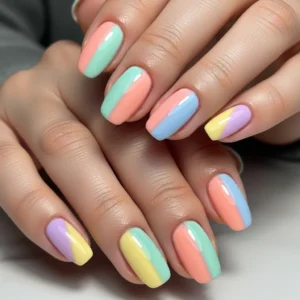
Color blocking is one of the stronger nail inspo directions for spring 2026. Each nail is divided in half, diagonally or straight across, with two contrasting pastels. Lavender and mint, peach and sky blue, or butter yellow and soft pink are all working well this season.
Use nail striping tape to get a clean dividing line. Apply the first color, let it dry completely, press the tape down firmly (pay attention to the sidewalls — that’s where color bleeds most), then apply the second color. Remove the tape before that second color fully dries.
Ombre Pastel Gradients
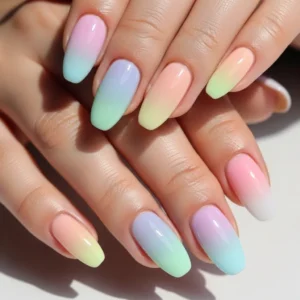
A spring gradient using a makeup sponge is still one of the most effective techniques for blending two sheer colors from the lunula to the free edge. Apply both polish colors side by side on the sponge in a thin line, then press and dab gently across the nail plate.
Expect to do three to four sponge passes for good color payoff. The second coat goes on smoother because the first layer gives the sponge something to grab onto.
Single-Tone Pastel With Negative Space
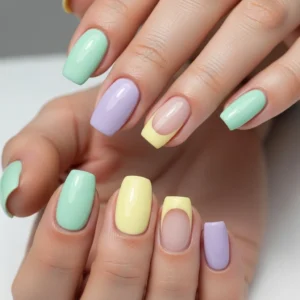
Sometimes the most effective nails inspo is also the simplest. A solid pastel color — true mint, powdery lilac, or a warm butter yellow — with a clean negative space gap near the lunula looks editorial without requiring any tools beyond a steady brush hand.
Use tape to create the clean arc near the cuticle line if you don’t trust a freehand approach. Most people don’t naturally have a steady enough hand for this, and tape takes the pressure off completely.
Minimalist and Graphic Spring Nail Designs
Single Line Art
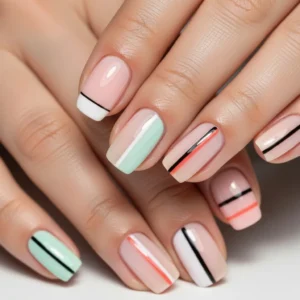
A single fine stroke across the nail plate — horizontal, diagonal, or curved — is one of the cleaner graphic nail looks trending this spring. Use a liner brush and an opaque contrasting color. White lines on a pastel base, or a warm coral line on a sheer beige base, both land well.
The key is pulling the brush in one continuous stroke rather than building the line up in sections. Multiple strokes create an uneven width that shows up more than you’d expect once the top coat goes on.
Chrome and Pearl Accents
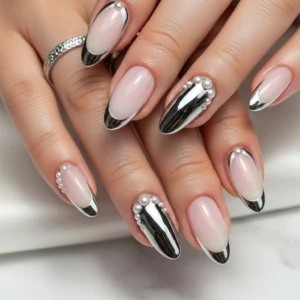
Nail techs have been calling chrome powder accents the finishing touch of 2026. You don’t need to do a full chrome nail — applying the powder just to the apex of the nail or along the free edge creates a detail that catches light differently than a glitter or foil finish.
Chrome powder requires a gel base to adhere properly. Apply a no-wipe gel top coat, cure it partially under a gel-cure lamp (about 10 seconds instead of the full 60), then rub the chrome powder on with a silicone applicator or your fingertip.
French Tip Variations
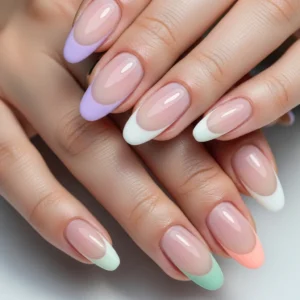
The classic French tip is back, but the shape has evolved. Colored tips in lavender, peach, or seafoam on a sheer base are replacing the stark white. Curved tips that follow the natural free edge look more modern than the straight-across version from ten years ago.
A tip guide sticker makes this dramatically easier. Place it just below where you want the color to end, apply your colored tip polish, and remove the guide while the polish is still wet for a clean line.
Textured and 3D Spring Nail Inspo
Boucle and Velvet Texture
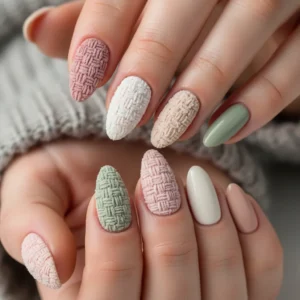
Sugar-finish top coats and flock powders create a matte, fabric-like surface that photographs extremely well and feels genuinely different from typical polish finishes. The texture is applied over a cured gel base coat while it’s still tacky.
This finish does chip faster than a smooth gel, especially on the free edge. Keeping nails shorter while wearing textured finishes extends the wear time noticeably.
Pressed Petal and Foil Mix
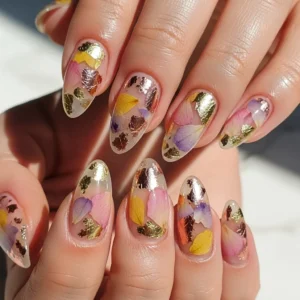
Combining real pressed petals with small foil pieces creates a layered, botanical look that’s heavily circulating this season. Alternate petals and foil fragments across the nail for an effect that’s deliberately unstructured.
Apply petals and foil over a tacky gel layer, seal with a thick builder gel or a thick gel top coat to prevent lifting at the edges.
Also Read: 15 Easy Floral Nail Designs for Beginners You Can Do at Home
Common Mistakes and How to Fix Them
Flooding the cuticle line with polish: This happens when you load too much product on the brush and start the stroke too close to the cuticle. The fix is to leave a small gap about 1mm between the polish and the cuticle line. Cuticle oil applied after the mani can soften and push back any skin that makes the gap look wider than intended.
Streaky sheer polish: Sheer formulas don’t self-level the same way opaque ones do, and dragging the brush back and forth creates streaks. Apply in one direction only, from the cuticle to the free edge, in three stripes – left, center, right. Do not stroke back.
Nail striping tape pulling up the color underneath: This happens if you remove the tape too late or if the polish underneath wasn’t fully cured. Remove tape at a slow, low angle while the top layer is still slightly wet, not after it has hardened. If color pulls anyway, fix the edge with a fine brush and a small amount of the base color, then re-seal.
Chrome powder not adhering evenly: The most common cause is over-curing the gel before applying powder. The gel surface needs to stay slightly tacky. If the chrome looks patchy or won’t buff to a mirror finish, the gel cured too long. Wipe the surface with a lint-free wipe and a small amount of 91% isopropyl alcohol, apply a fresh thin layer of no-wipe gel, and try again.
Conclusion
Spring nails in 2026 are pulling from a wide range of directions — sheer and soft on one end, graphic and structured on the other. The designs in this article cover that full range, from jelly-tinted washes that take almost no skill to chrome details and color-blocked geometric looks that reward patience and practice.
The honest truth is that most of these designs get better with repetition. The first time you try a striping tape block or a chrome powder application, it probably won’t be perfect. The second time, it will be noticeably better. That’s how nail art actually works for people who do it at home.
Frequently Asked Questions
1. What nail shape is most popular for spring 2026?
Soft oval and almond shapes are the most requested at salons right now. They balance length with wearability, and they work well with both detailed nail art and simpler one-color looks. Square-with-rounded-corners (sometimes called squoval) is also popular for shorter nail lengths.
2. How do I make spring nail designs last longer at home?
Start with a nail dehydrator or prep solution before any polish. Apply a quality base coat, keep layers thin, and always seal the free edge with your top coat. Cuticle oil daily after the manicure keeps the surrounding skin healthy, which reduces lifting at the sidewalls.
3. Can beginners do floral nail art without a brush?
Yes. A dotting tool or the end of a bobby pin makes simple five-petal flowers that look intentional without requiring fine brush control. Dot five petals in a circle, add a contrasting center dot, and you have a clean floral design that holds up at any skill level.
4. What is the difference between gel and regular nail polish for spring nail art?
Regular polish dries through evaporation and is more forgiving for beginners. Gel requires a UV or LED cure lamp but lasts two to three weeks without chipping when applied correctly. For detailed nail art, gel formulas give you more working time before they set, which makes designs like watercolor florals or petal placement easier to control.
5. How do I do an ombre nail without a sponge?
A fan brush works as an alternative. Apply both colors side by side on the brush, then lightly sweep across the nail where you want the blend to happen. It gives slightly less diffused blending than a sponge but is easier to control for smaller nail surfaces.

I’m Janice, a New York City–based nail artist and DIY beauty writer with 8+ years of hands-on experience. I specialize in gel techniques, acrylic extensions, nail stamping, and seasonal trends.
Every product and method I share is personally tested, so you get practical, honest guidance you can trust. My goal is to help you achieve salon-quality nails at home—whether you’re a beginner or ready to level up your skills.
Nice and very informative article.